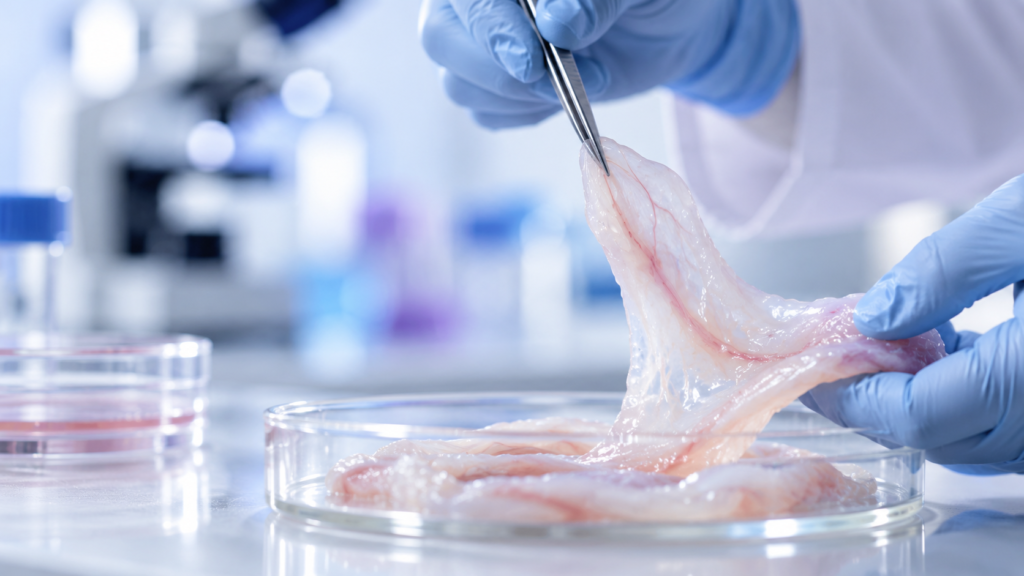
For physicians following regenerative medicine, Wharton’s jelly-derived mesenchymal stromal cells have remained an area of interest because of their accessibility, proliferative capacity and broad secretory activity. One frequently cited study examined not only the cells themselves, but also the conditioned medium they produced – raising an important question that continues to shape regenerative medicine research today: how much of a mesenchymal stromal cell’s therapeutic potential comes from the cell, and how much may come from the signals it releases?
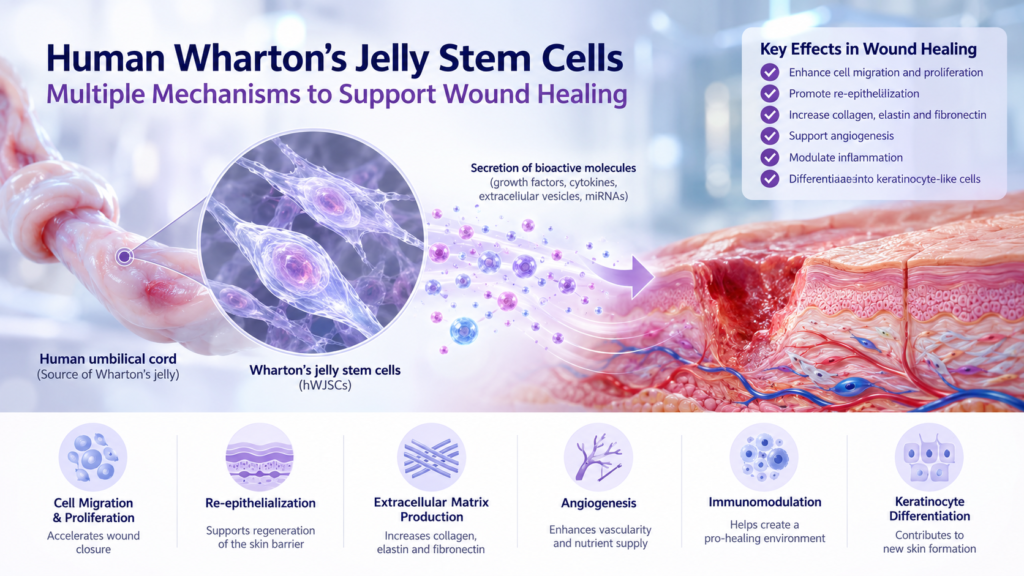
The featured 2014 study by Fong and colleagues provides an early preclinical look at this question in wound repair. Its findings are scientifically relevant, particularly when read alongside more recent work on the mesenchymal stromal cell secretome, extracellular vesicles and cell-free regenerative approaches. However, the study should be interpreted as preclinical evidence rather than a clinical treatment protocol.
WHY WOUND HEALING REMAINS A MAJOR REGENERATIVE MEDICINE TARGET
Chronic and diabetic wounds are biologically difficult because normal repair can become disrupted across inflammation, proliferation, re-epithelialization, angiogenesis and tissue remodeling. For clinicians, regenerative strategies are therefore of interest not simply because they may help cover a wound, but because they may influence the cellular environment that supports vascularization, extracellular-matrix formation, epithelial recovery and more durable tissue repair.
Among the cell sources being studied, mesenchymal stromal cells derived from human umbilical cord tissue – including Wharton’s jelly – have received sustained attention. Their appeal is linked to the availability of the tissue source, expansion potential and the variety of bioactive molecules they can release.
A 2023 review of the Wharton’s jelly MSC secretome describes a complex mixture of cytokines, chemokines, growth factors, angiogenic mediators, extracellular vesicles and regulatory nucleic acids. This has strengthened interest in the idea that some regenerative effects of MSCs may be mediated through paracrine signaling rather than long-term engraftment alone.
WHAT THE 2014 STUDY ACTUALLY EXAMINED
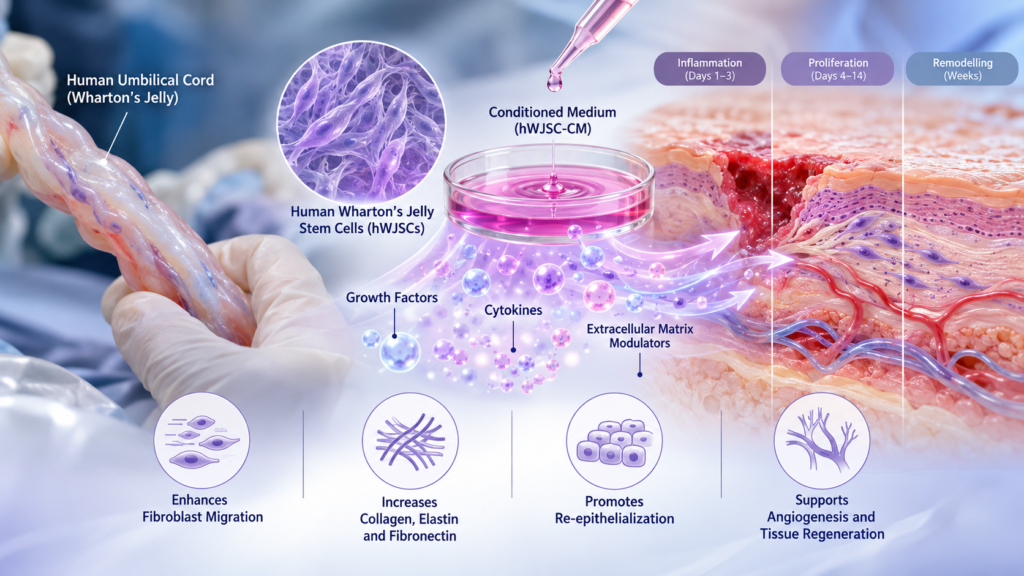
Fong and colleagues investigated human Wharton’s jelly stem cells (hWJSCs) and hWJSC-conditioned medium (hWJSC-CM) using two levels of preclinical experimentation: fibroblast-based wound assays in vitro and full-thickness excisional and diabetic wound models in mice.
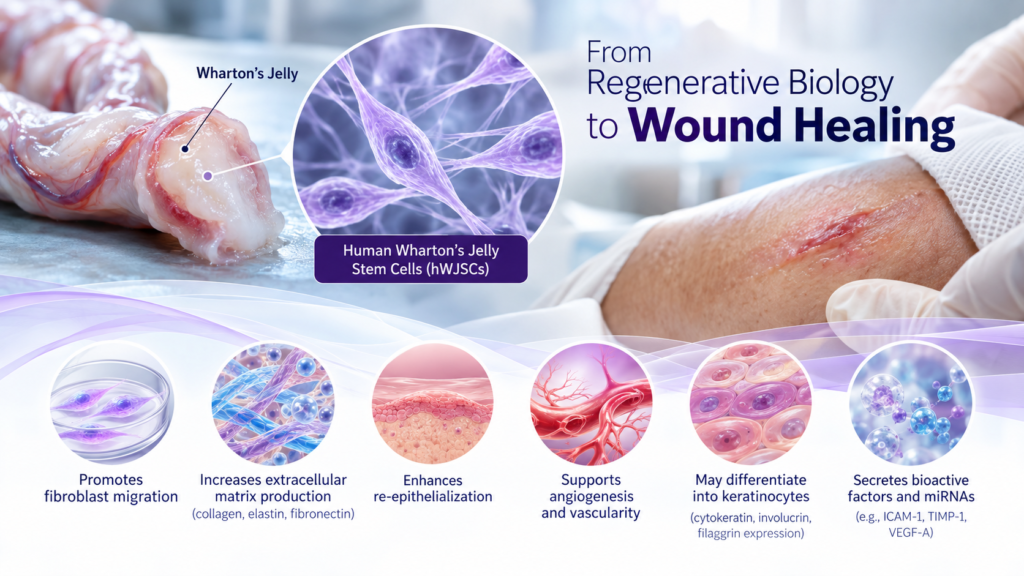
At a high level, the investigators reported that fibroblasts exposed to hWJSC-CM migrated into the experimental wound space more rapidly than controls. They also observed changes involving extracellular-matrix components including collagen, elastin and fibronectin.
In the animal models, wounds treated with hWJSCs or conditioned medium showed greater healing activity than controls, together with histologic findings involving re-epithelialization, cellularity and vascularity.
One reason the study remains worth revisiting is that it did not evaluate transplanted cells alone. It also tested conditioned medium. That distinction anticipated an important direction in regenerative medicine: the possibility that a meaningful part of MSC activity may be mediated through secreted factors.
THREE BIOLOGICAL SIGNALS THAT DESERVE ATTENTION
- Fibroblast migration and extracellular-matrix remodeling
Fibroblasts are central to granulation tissue formation and matrix organization. In the 2014 study, exposure to hWJSC-CM was associated with increased fibroblast migration and higher measures of matrix-related proteins.
For a physician reading the paper today, the important message is mechanistic. A regenerative effect may involve changing the local wound environment in ways that support repair rather than simply replacing damaged cells.
- Re-epithelialization and vascular signaling
The investigators also examined tissue changes and molecular signals associated with epithelial recovery and angiogenesis. VEGF-A, TIMP-1 and ICAM-1 were among the signals assessed.
These pathways remain relevant to wound biology because successful healing requires coordinated vascular supply, cell adhesion, extracellular-matrix turnover and restoration of an epithelial barrier.
- The secretome as a cell-free research direction
Conditioned medium is an early and relatively broad representation of what is now more commonly discussed as the MSC secretome. Contemporary research increasingly separates the secretome into soluble proteins, extracellular vesicles, exosome-enriched fractions and other components.
A systematic review of preclinical skin-wound studies reported generally favorable effects of MSC secretome approaches on wound closure, re-epithelialization, neovascularization and collagen remodeling. Importantly, the same review also highlighted substantial heterogeneity in experimental design, secretome preparation and methodology. This is a key limitation when attempting to compare one preparation with another.
WHAT NEWER EVIDENCE ADDS – AND WHAT IT DOES NOT YET SETTLE
Since the 2014 paper, the field has continued to investigate whether MSC-derived secretory products can be translated beyond laboratory models.
A 2023 systematic review and meta-analysis evaluated secretome-based approaches across several human wound-related clinical parameters and reported signals of benefit in outcomes such as ulcer size and depth. The evidence base was limited and heterogeneous, reinforcing the need for better standardization and larger studies.
A 2024 systematic review examining stem-cell approaches in wound healing similarly described encouraging findings across multiple stem-cell sources while emphasizing variation in cell type, wound indication, delivery method and study quality.
More recently, a 2025 study using secretome derived from prolonged high-density human Wharton’s jelly stem cell culture reported enhanced wound-related responses in cell assays, a three-dimensional human skin equivalent and an acute rat wound model. This work is particularly relevant to translation because it also considered scalable secretome production.
Human evidence is beginning to emerge, but it remains early. A 2025 single-center, open-label phase I/II study enrolled 10 patients with chronic diabetic foot ulcers treated with human umbilical-cord MSC derivatives. The investigators reported complete ulcer closure in all participants, with no significant adverse events, and called for larger randomized, double-blind, placebo-controlled trials to confirm the findings.
For doctors, this is an important distinction: an encouraging early human signal is not the same as definitive clinical evidence.
WHY STANDARDIZATION MATTERS
The term “Wharton’s jelly therapy” can imply a level of uniformity that does not necessarily exist.
Product composition may vary according to donor characteristics, tissue processing, cell-isolation method, cell passage, culture conditions, oxygen tension, media composition, conditioning period, purification method, storage, potency testing and final formulation.
The same applies to terms such as conditioned medium, secretome, extracellular vesicles and exosomes. They describe related but non-identical biological preparations.
For this reason, results from one research product should not automatically be generalized to another product carrying a similar label.
CLINICAL TRANSLATION REQUIRES EVIDENCE, STANDARDIZATION AND RESTRAINT
The International Society for Stem Cell Research emphasizes that stem-cell and cell-derived interventions should progress through rigorous preclinical work, independent review and appropriately designed clinical trials before entering routine clinical care.
For physicians, this is particularly relevant in areas where biological plausibility is strong but commercial availability can move faster than the evidence.
Regulatory requirements also vary by jurisdiction. In the United States, for example, the U.S. Food and Drug Administration specifically identifies products involving Wharton’s jelly and exosomes among regenerative medicine products that may be subject to regulatory requirements and has warned about unapproved regenerative products marketed with unsupported treatment claims.
The broader lesson applies beyond one jurisdiction: a promising biological mechanism, a laboratory preparation and a validated clinical product are not interchangeable concepts.
QUESTIONS DOCTORS SHOULD ASK WHEN EVALUATING THIS FIELD
What exactly is the intervention?
Is the proposed intervention composed of live cells, conditioned medium, extracellular vesicles, an exosome-enriched fraction or another derivative?
How was it manufactured and characterized?
Cell source, donor screening, expansion conditions, sterility, potency, batch consistency, storage and release criteria can materially affect the biological product.
What is the level of evidence?
In vitro experiments, animal models, early-phase human studies and randomized controlled trials answer different questions and should not be treated as equivalent evidence.
What was the comparator?
A regenerative intervention intended for wound care ultimately needs to be assessed against appropriate standard wound management rather than only against untreated laboratory controls.
Were safety, ethics and regulatory requirements addressed?
These are fundamental components of clinical quality and should be evaluated alongside efficacy claims.
WHAT THE 2014 PAPER DOES – AND DOES NOT – TELL US
The Fong et al. study supports continued scientific interest in Wharton’s jelly-derived MSCs and their secreted factors. It provides preclinical evidence involving fibroblast migration, extracellular-matrix activity, wound closure, re-epithelialization, vascular-related signaling and possible keratinocyte differentiation.
What it does not provide is a validated human treatment protocol, an optimal dose, a standardized commercial formulation or proof that different Wharton’s jelly-derived products are clinically equivalent.
That distinction is essential when translating regenerative medicine research into responsible clinical discussion.
CONTINUE THE DISCUSSION AS AN ASRM MEMBER
This public article provides an overview of the scientific questions raised by the research, but it intentionally does not reproduce the complete methodology, figure-by-figure findings, detailed marker-level interpretation or the full translational discussion.
ASRM members can go deeper through the Society’s professional education resources, scientific programmes and exclusive publications – including more detailed discussion of emerging evidence, study limitations, regenerative protocols and the questions clinicians should consider before adopting new approaches into practice.
Learn more about ASRM Membership:
https://asiansocietyregenmed.org/membership/
For more information:
info@asiansocietyregenmed.org
PROFESSIONAL EDUCATION NOTE
This article is an evidence-focused educational summary intended for medical professionals. It does not recommend a specific commercial product or establish a clinical treatment protocol.
SOURCES AND FURTHER READING
- Fong CY, Tam K, Cheyyatraivendran S, et al. Human Wharton’s Jelly Stem Cells and Its Conditioned Medium Enhance Healing of Excisional and Diabetic Wounds. Journal of Cellular Biochemistry. 2014;115:290-302. doi:10.1002/jcb.24661.
- Drobiova H, Sindhu S, Ahmad R, Haddad D, Al-Mulla F, Al Madhoun A. Wharton’s jelly mesenchymal stem cells: a concise review of their secretome and prospective clinical applications. Frontiers in Cell and Developmental Biology. 2023;11:1211217. doi:10.3389/fcell.2023.1211217.
- Mesenchymal Stromal Cell Secretome for Therapeutic Application in Skin Wound Healing: A Systematic Review of Preclinical Studies. PubMed PMID: 35871510.
- Suhandi C, Mohammed AFA, Wilar G, El-Rayyes A, Wathoni N. Effectiveness of Mesenchymal Stem Cell Secretome on Wound Healing: A Systematic Review and Meta-analysis. Tissue Engineering and Regenerative Medicine. 2023;20(7):1053-1062. doi:10.1007/s13770-023-00570-9. PMID: 37682505.
- Farabi B, Roster K, Hirani R, et al. The Efficacy of Stem Cells in Wound Healing: A Systematic Review. International Journal of Molecular Sciences. 2024;25(5):3006. doi:10.3390/ijms25053006.
- Chin JS, Tan MLL, Lim PLK, et al. Secretome from prolonged high-density human Wharton’s jelly stem cell culture accelerates wound healing in both in vitro and in vivo models. International Wound Journal. 2025;22(5):e70033. doi:10.1111/iwj.70033.
- Jafar H, Almousa R, Alhawari H, et al. Human umbilical cord mesenchymal stromal cells derivatives in treating diabetic foot ulcers: a phase I/II safety and efficacy trial. Stem Cell Research & Therapy. 2025;16:657. doi:10.1186/s13287-025-04736-1.
- International Society for Stem Cell Research. Guidelines for Stem Cell Research and Clinical Translation. Clinical Translation of Stem Cell-Based Interventions. 2025 edition.
- U.S. Food and Drug Administration. Important Patient and Consumer Information About Regenerative Medicine Therapies.